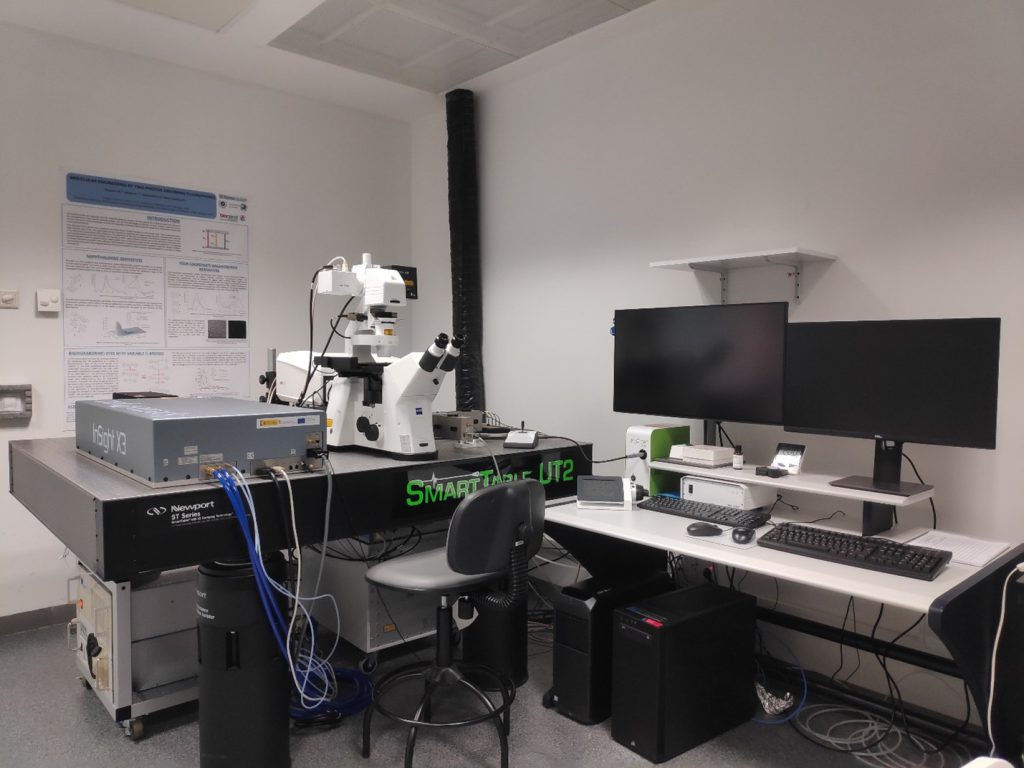





Confocal Microscopy
Multi- or two-photon (2P) microscopy takes advantages of the near simultaneous absorption of two or more photons which act to excite a fluorescent molecule with the combined energy of all the photons. In practice, this means that lower energy infrared (IR) light can be used to see fluorescent molecules that are normally excited by high energy ultraviolet and visible wavelength. As IR light is less susceptible to diffusion and absorption, we can visualise fluorescent molecules at greater depths than conventional microscopy. Infrared light also tends to beless damaging to live tissues than UV or blue excitation, making it ideal for timelapse imaging of model organisms or tissue explants.
Customer benefits
We have SOPs and ISO9001 certification. We also have specialist technicians for the use of the equipment.
This service is essential to:
- 3D imaging of fixed multi-color immunofluorescence preparations.
- FRAP (Fluorescence Recovery after Photobleaching) and photoactivation methods for studying molecular dynamics.
- Foster Resonance Energy Transfer (FRET) for studying molecular interactions at sub–nanometric distances.
- Characterization of single (1P) and two (2P) photon fluorescence properties of novel materials in vitro and in vivo.
Two-photon deep tissue imaging (>100 microns) of fluorescent proteins
Target customer
Any company or research group interested in:
- Integrated cellular interaction analyses; we offer rapid assays analyzing uptake and subcellular localization of fluorescently-labeled molecules in standard cultured cell lines
- Quantitative, semi-quantitative, and comparative analyses of fluorescent expression/staining in different models. We can advise on the required controls or limitations of different methodologies
- Co-localisation studies comparing localization with standard sub-cellular markers, fluorescent proteins, and antibodies with rigorous statistical analysis performed using commercial (IMARIS) and open-source (FIJI) co-localization analysis tools.
- 3D quantification and visualization using the advanced IMARIS 3D analysis package, including volume quantification, 3D object tracking, and cell type and subcellular organelle counting
- Two-photon emission and excitation spectra measurements and Quantum efficiency (QE) estimation by comparison with reference compounds.
- High-resolution intravital imaging of sub-surface tissues taking advantage of higher tissue penetration of two-excitation